Sunday Eucharist | 10:30 (Choral)
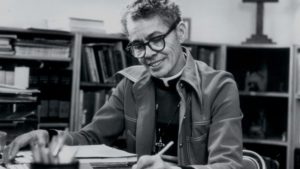
I knew nothing about Pauli Murray before I moved to Greensboro, North Carolina, a city that—for good reasons—has a lot of awareness of its civil rights history. Since then, Pauli Murray has become one of my favorite historical figures—an astonishingly smart, accomplished, and effective woman of color whose legal research has made a real difference in social justice for women and Black people in the United States, and also in Ghana, where she briefly researched and taught. In 2012 Murray was added to the Episcopal Calendar of Holy Women and Holy Men on July 1 (the day she died).
Anna Pauline “Pauli” Murray (1910–1985) is best known for her legal writing addressing civil rights and women’s rights; it was transformational in landmark Supreme Court cases like Brown v. Board of Education. Civil rights litigators like Thurgood Marshall and Ruth Bader Ginsburg, for example, cited her edited compilation States’ Laws on Race and Color (Commissioned by United Methodist Women, 1951) in their successful cases on discrimination in education, transportation, voting, and other rights. Murray’s ordination as an Episcopal priest (1977) late in her life seems like a footnote to her biography, but her memoir, Song in a Weary Throat, attests that her engagement with the Episcopal church began early in her life in the mission churches for “colored” folks in North Carolina, and with her uncle, who was a pastor.
Pauli’s Episcopalian heritage informed her social ethics, although it should be noted that historically Episcopalians in the Southern U.S. tended to be white planters who retained black enslaved people. “Parish” churches were self-supporting white churches, while “mission” churches served people of color, including Murray, who was of mixed race on both her mother’s and her father’s side. Abolitionists tended to be Quakers.
While some educational and professional opportunities were foreclosed to Murray because she was Black, others were foreclosed because she was female (e.g., Harvard Law). But she still attained prestigious positions, such as at the law firm Paul, Weiss, where not only was she an attorney in the litigation department, but she also met Irene Barlow, her partner until Barlow’s death in 1973. In addition to being a practicing attorney, Murray was a professor of law at several institutions, including Brandeis, where she taught a graduate seminar in law and social justice.
Her long involvement with civil rights activism led her to theorize that not only Jim Crow, but also Jane Crow was afoot, including in the civil rights movement itself: she regarded the male leadership of the movement to be resistant to equal participation by women, relegating them to supporting, rather than leadership, roles. She cultivated a close friendship with Eleanor Roosevelt, and they worked together on issues of racial and gender equity; she also founded the National Organization for Women (NOW) with Betty Friedan.
After her partner Irene passed away, Murray more urgently felt her call to theology and entered the seminary, even though the Episcopal Church was not yet ordaining women. That was a big risk, but her judgment was vindicated: she became the first Black woman to be ordained as an Episcopal priest.
Recently people have wondered whether Murray should be regarded as transgender. Part of the argument is that she passed as a teenage boy when she was a teenage girl, that she felt her sexual feelings were “inverted,” an old-fashioned term for homosexual (which itself is now an old-fashioned term); that she worried that she might have male testes inside her abdomen and wanted doctors to check (they declined), and she wanted to have testosterone treatments (which were denied). All of these concerns date from the period of her late teenage years into her early thirties. There has been no published evidence that these concerns continued after she began her relationship with Irene Barlow (~1960), and Murray seems to have had no trouble identifying with the women she was defending from injustice. So whether those cross-gender desires remained and were sublimated in some way, or whether she just settled into the role of a garden-variety lesbian is not clear. But this we know: The Pauli Murray Center in Durham, NC, which is housed in the residence Pauli Murray shared with her Aunt Pauline, is part of the National Parks system, and their online biography of Murray was edited without their permission by someone else in the federal government, and whoever did the editing removed three pages and altered parts of their description of Murray’s biography that concern her sex and gender. And that ain’t right.
Bibliography:
Bell-Scott, Patricia. The Firebrand and the First Lady: Portrait of Friendship. Pauli Murray, Eleanor Roosevelt, and the Struggle for Social Justice. New York: Vintage Books, 2017.
Murray, Pauli. Song in a Weary Throat: Memoir of an American Pilgrimage. New York: Liveright Publishing, 1987.
Rosenberg, Rosalind. Jane Crow: The Life of Pauli Murray. New York: Oxford University Press, 2017.
The Episcopal Diocese of North Carolina. Pauli Murray. https://www.episdionc.org/about-us/our-priorities/formation/north-carolina-saints/pauli-murray/. Accessed 22 June 2025.
Pauli Murray Center for History and Social Justice. https://www.paulimurraycenter.com/