Sunday Eucharist | 10:30 (Choral)

Review: 2025-06-12
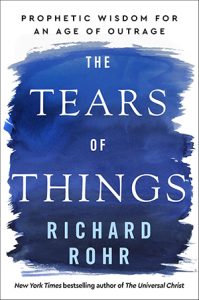
Richard Rohr. The Tears of Things: Prophetic Wisdom for an Age of Outrage. New York: Convergent, 2025.
The latest and perhaps last book by Richard Rohr, now 82, is summative and personal, bringing a lifetime of spiritual practice and teaching into focus through an overview of many of the more than thirty prophets who appear on the pages of the Bible. He includes both Job and Jesus as prophets and urges readers to take Jesus more seriously as a prophet who speaks from within the prophetic tradition.
Rohr sees this company of prophets through his eyes as a mystic. He does not emphasize the distinction between prophetic religion and mystical religion, as Friedrich Heiler did in his classic 1932 book on prayer. Early in the book, Rohr lays out a three-stage pattern of spiritual development, “the stages any of us go through as we grow up spiritually,” as a template for his reflections on the prophets; he suggests that we use this pattern as a heuristic tool for reading the prophetic books of the Bible (Tears of Things 10-16). The three stages consist of order – religion as a dualistic system of wrath, punishment, and rewards; disorder – the experience of uncertainty, sorrow, chaos, confusion, searching, and yearning; and reorder – breaking through into nondual awareness of the power of love in the midst of a world of grief. He uses these stages throughout the book as he sketches the spiritual development of several of the prophets. This analysis seems to be a version of the threefold sequence that is central in Walter Brueggemann’s study of the Psalms: orientation, disorientation, and new orientation (The Message of the Psalms 15-23; Rohr acknowledges Brueggemann as one of his sources on page 170). Later in the book (Tears 106) he refers to purgation, illumination, and union, the classic three stages of mystical development laid out in Evelyn Underhill’s 1911 study, Mysticism. It is not clear whether this implicit reference to Underhill is a reiteration of Rohr’s own three stages.
The dynamic ground at the heart of the book is the human vulnerability that opens us up to these transformations. The title, The Tears of Things, sums up this opening, this dynamic ground in one phrase. Tears transform: with the prophets we can “progress through various stages of bargaining, conviction, epiphany, deeper God experience – followed by extended passages of further threat, seductive promises, warnings, and fear – until they lead us toward and through their own needed deconstruction and into their eventual reconstruction. The old dies irae refrain morphs into the cosmic dance of life” (Tears 10-11). Like Rohr, Brueggemann makes lament central to his vision of spirituality as well. He calls the US church to account for its neglect of the experience of lament and its benefits (see his article, “The Tragic Loss of Lament”).
Rohr points out that not all prophets develop through all three stages: some remain what he calls “unfinished prophets” as opposed to “mature prophets.” His distinction here hinges on whether a prophet goes beyond dualistic systems of rewards and punishment and comes to a nondual understanding of the immediacy of God’s presence and love, the hallmark of the third stage. To Rohr, Elijah, Jonah, and John the Baptizer stand out as “unfinished prophets” (Tears 81-95), while most of the others he discusses seem to fit the complete pattern.
Rohr’s references show that he is eclectic in his approach to spirituality: the book as a whole shows the influence of René Girard’s concept of “scapegoating” (Tears xx, 35, 147); he mentions Eckhart Tolle as a prophet (Tears 59); he refers twice to Ken Wilber, a synthesizer who practices a form of Buddhist spirituality (Tears xvii, 13); he quotes from the Buddhist “Heart Sutra” (Tears 58-59); he also uses Jungian terms, such as the shadow and the alchemy of the soul, with familiarity. He makes several references to the ego as an obstruction to universal compassion. Elsewhere he has written of the distinction between the false self (ego centered) and the true self (compassion centered), which he derived early on from Thomas Merton (see Rohr, Immortal Diamond: The Search for Our True Self 2012).
Along the way Rohr develops a major teaching, his concept of “remnant theology” (Tears 29-43). The remnant consists of the spiritually-attuned few across time who live in a way that keeps faith alive and renewed in opposition to the mainstream culture. (In an aside, he reflects that the first two thousand years of Christianity track closer to John the Baptizer’s “unfinished” prophetism when it could have hewn closer to the more interior nondual spirituality of Jesus as the teaching of a “mature prophet,” Tears 90)
Rohr warns of the human tendency to gravitate to the fantasy of “innocence” as an ersatz way Evangelicals and others hold onto facets of the “untransformed self” (Tears 12). This fantasy of innocence allows people to avoid living within the dynamic power of forgiving and being forgiven that realistically acknowledges and lets go of our inherent guilt in the ocean of God’s grace: “The Christian religion has sought to achieve its own innocence rather than act in solidarity with suffering and sinners” (Tears xxi).
Rohr no doubt rightly sees himself as a voice of the remnant today and as a prophetic critic who “lives on the edge of the inside without totally exiting the fold” (Tears 54). The voice that comes across in these pages is that of one who has a deep sense of “inner sustainment” achieved through decades of spiritual practice. “We can only learn great things gradually,” he writes. It is no wonder that people sense that voice and turn to it again and again.
Richard Rohr. “Daily Meditation: Letting Go of Our Innocence.” Friday, August 5, 2022
Letting Go of Our Innocence — Center for Action and Contemplation
In this talk, Richard shares about the freedom we gain from “letting go” of any false images of ourselves as totally innocent or pure. We find the courage to be who we are in God and to join God in the flow of grace:
We come to God not by doing it right, but by doing it wrong. And yet the great forgiveness is to forgive ourselves for doing it wrong. That’s probably the hardest forgiveness of all: that I’m not perfect, that I’m not unwounded, I’m not innocent. “One always learns one’s mystery at the price of one’s innocence.” [Robertson Davies, Fifth Business (Toronto, ON: Macmillan, 1970), 305]. If I want to maintain an image of myself as innocent, superior, righteous, or saved, I can only do that at the cost of truth. I have to reject the mysterious side, the shadow side, the broken side, the unconscious side of almost everything.
The art of letting go really is the way to heaven because when we fall down there to the bottom, we fall on solid ground, the great foundation. . . . On that foundation where we have nothing to prove, nothing to protect, we have met the enemy and the enemy is us. I am who I am who I am, and for some unbelievable reason, that’s what God has chosen to love. . . .
Letting go is different than denying or repressing. To let go of it, we have to admit it. We have to own it. Letting go is different than turning it against our self. Letting go is different than projecting onto others. Letting go means that the denied, repressed, rejected parts of our own self which are nonetheless true are seen for what they are, but not turned against self or against others, so letting go is not denial. It’s not pretend. The religious word for letting go is the word “forgiveness.” This is the positive way to deal with our own woundedness. We see it and we hand it over to God. We hand it over to history. . . .
The mode of weeping, of crying, is different than fixing. It’s different than understanding. That’s why we often cry when we forgive. . . . When we can’t fix it, when we can’t explain it, when we can’t control it, when we can’t even understand it, we can only forgive it. Let go of it, weep over it. It’s a different mode of being. . . .
I can see why forgiveness is almost the heart of the matter, and Jesus’ prerequisite for being forgiven by God is simply to forgive one another. . . . Jesus said we will receive the forgiveness of God to the degree that we can be conduits of forgiveness for one another. In other words, forgiveness is of one piece. Those who give it can receive it. Those who receive it can give it. If we’re in the conduit of love, if we’re in the ocean of mercy, frankly, it’s the only thing that makes sense.
C. S. Lewis on love as vulnerability:
St. Augustine [wrote]: “Do not let your happiness depend on something you may lose. If love is to be a blessing, not a misery, it must be for the only Beloved who will never pass away.”
[But] there is no escape along the lines St. Augustine suggests. Nor along any other lines. There is no safe investment. To love at all is to be vulnerable. Love anything, and your heart will certainly be wrung and possibly be broken. If you want to make sure of keeping it intact, you must give your heart to no one, not even to an animal. Wrap it carefully round with hobbies and little luxuries; avoid all entanglements; lock it up safe in the casket or coffin of your selfishness. But in that casket—safe, dark, motionless, airless—it will change. It will not be broken; it will become unbreakable, impenetrable, irredeemable. The alternative to tragedy, or at least the risk of tragedy, is damnation. The only place outside Heaven where you can be perfectly safe from all the dangers and perturbations of love is Hell.
. . . If a person is not uncalculating towards the earthly beloveds whom he has seen, he is none the more likely to be so towards God whom he has not. We shall draw nearer to God, not by trying to avoid the sufferings inherent in all loves, but by accepting them and offering them to Him; throwing away all defensive armor.
— The Four Loves 120-22
“Vulnerability”By David Whyte (@Whytedw), Special Contributor
Vulnerability is not a weakness, a passing indisposition, or something we can arrange to do without, vulnerability is not a choice, vulnerability is the underlying, ever present and abiding undercurrent of our natural state. To run from vulnerability is to run from the essence of our nature, the attempt to be invulnerable is the vain attempt to become something we are not and most especially, to close off our understanding of the grief of others. More seriously, in refusing our vulnerability we refuse the help needed at every turn of our existence and immobilize the essential, tidal and conversational foundations of our identity.
To have a temporary, isolated sense of power over all events and circumstances, is a lovely illusionary privilege and perhaps the prime and most beautifully constructed conceit of being human and especially of being youthfully human, but it is a privilege that must be surrendered with that same youth, with ill health, with accident, with the loss of loved ones who do not share our untouchable powers; powers eventually and most emphatically given up, as we approach our last breath.
The only choice we have as we mature is how we inhabit our vulnerability, how we become larger and more courageous and more compassionate through our intimacy with disappearance, our choice is to inhabit vulnerability as generous citizens of loss, robustly and fully, or conversely, as misers and complainers, reluctant and fearful, always at the gates of existence, but never bravely and completely attempting to enter, never wanting to risk ourselves, never walking fully through the door.
Excerpted with permission from Consolations: The Solace, Nourishment and Underlying Meaning of Everyday Words by David Whyte. https://onbeing.org/blog/vulnerability/
Cynthia Bourgeault, The Wisdom Jesus 43:
“Blessed are those who mourn, for they will be comforted.” When we mourn we are in a state of freefall, our heart reaching out toward what we have seemingly lost but cannot help loving anyway. To mourn is by definition to live between the realms. Ken Wilber: “Practice the wound of love. Real love hurts; real love makes you totally vulnerable and open; real love will take you far beyond yourself; and therefore real love will devastate you” (Grit 401).
Mourning is a brutal form of emptiness. But in this emptiness, if we can remain open, we discover that a mysterious “something” does indeed reach back to comfort us; the tendrils of our grief trailing out into the unknown become intertwined in a greater love that holds all things together. To mourn is to touch directly the substance of divine compassion. And just as ice must melt before it can begin to flow, we, too, must become liquid before we can flow into the larger mind. Tears have been a classic spiritual way of doing this.